The short answer
Before a pool inspection in NSW, check that the fence is at least 1.2 m high all the way around, with no gap over 10 cm under it or through it. Make sure every gate opens away from the pool and closes and latches by itself from any position, and that nothing climbable sits within 900 mm of the top of the fence. Check that no door or window gives a child a way into the pool area, that the CPR sign is readable from 3 m, and that the pool is registered. This list helps you find problems early, but the assessment that counts is the one a registered certifier or your council makes on site.
How to use this pool compliance checklist
The NSW Swimming Pool Register published self-assessment checklists for owners, one for each age and type of pool: newer pools, older pools, spas, waterfront properties and so on. Councils still host copies of them. The items below follow the checklist for pools built after 1 May 2013, together with the NSW Government's guide for pool owners.
Older pools may be measured against an older Australian Standard and may have been assessed differently, so a few items can differ for them. Treat this as a list of what a certifier will look at, not as the law in full. The certifier's assessment on the day is what decides whether you get a certificate.
Take a tape measure, a 10 cm block or offcut of timber to use as a gap gauge, and your phone for photos. Walk the barrier from the outside first, then from inside the pool area.
Prefer to go one question at a time? The free pool barrier checker walks you through the same items and gives you a list to fix.
Pool fence: height and gaps
- The fence is at least 1.2 m high all the way around, measured from finished ground level on the outside.
- The gap between the bottom of the fence and the ground is no more than 10 cm anywhere along it.
- Gaps between vertical bars or glass panels are no more than 10 cm.
- Horizontal rails a child could climb are at least 90 cm apart.
- Mesh or perforated panels have holes no larger than 13 mm.
- Any boundary fence that forms part of the barrier is at least 1.8 m high, measured from inside the pool area.
- Panels, posts and spigots are firm, with no loose glass, broken welds or rusted-through posts.
Check the height on the outside at several points on every run. Built-up garden beds, mulch and new paving all reduce the height. The pool fence height guide explains how to measure each one.
Pool gates and latches
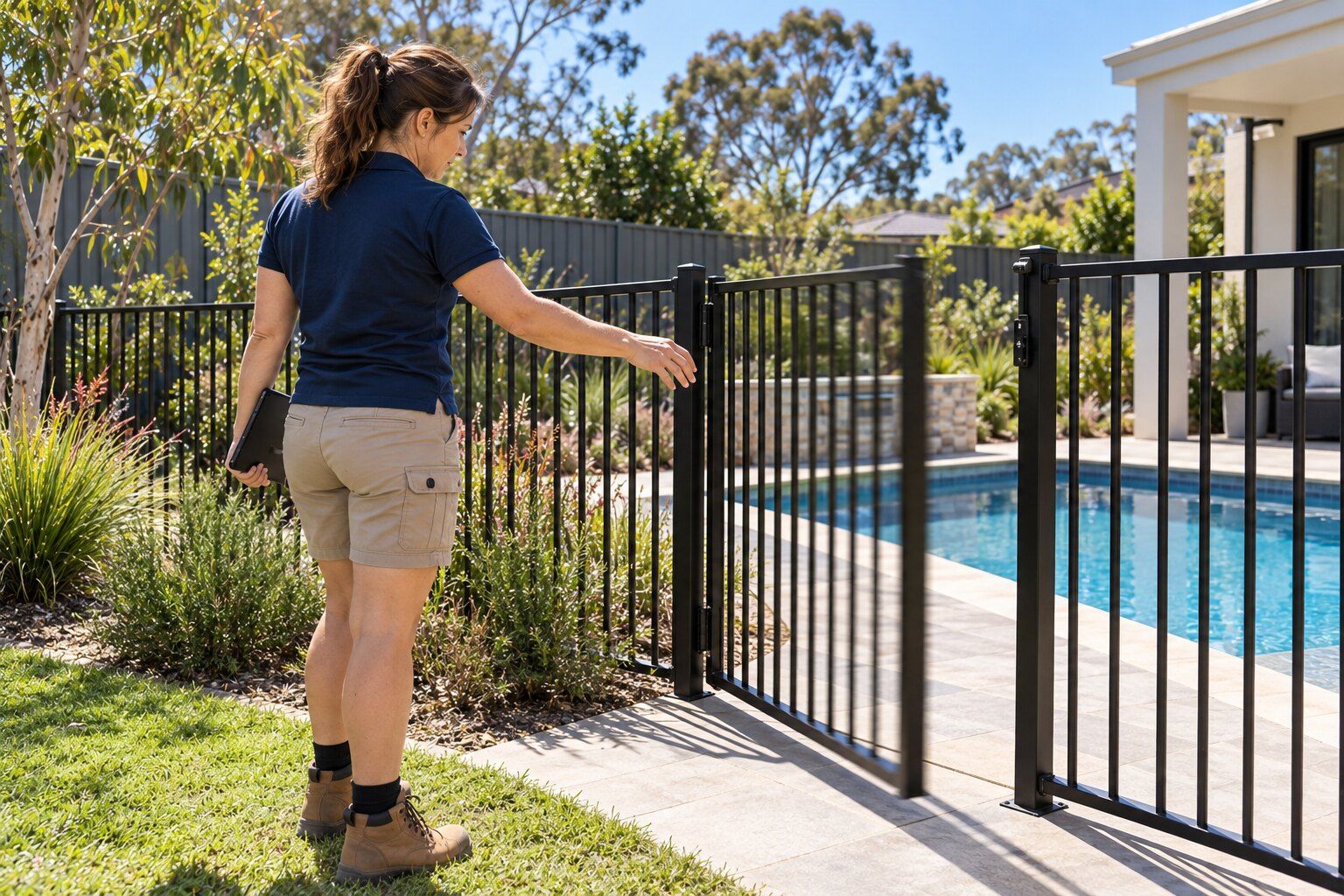
- Every gate opens outward, away from the pool.
- Every gate closes by itself and latches by itself from any open position. Test it from fully open, half open and just ajar.
- The latch release is 1500 mm above ground level. That is the register checklist's figure for pools built after 1 May 2013. The Australian Standard allows some other arrangements, so a certifier decides.
- The gate isn't propped, tied or wedged open, and there's nothing that stops it swinging shut.
- The gap under the gate is no more than 10 cm, the same as the fence.
Self-closing hinges can lose tension and gates can drop on their hinges, so a latch that once caught can start to miss. A fencing contractor can adjust or replace hinges and latches. See pool gate repairs.
Non-climbable zone and the area around the fence
- There are no hand holds or foot holds within 900 mm of the top of the fence in any direction on the outside.
- Pot plants, chairs, barbecues, eskies, bins and toys are well clear of the fence.
- Trees and shrubs haven't grown over or along the fence.
- Retaining walls, steps, taps and garden edging near the fence don't give a foothold within the zone.
- The 30 cm strip inside the pool area along the fence is clear.
These are the cheapest fixes on the list, but they have to stay fixed. A barrier has to remain compliant after the certificate is issued.
Doors, windows, the CPR sign and paperwork
- Check whether any door from the house opens straight into the pool area. The NSW Government's guide says doors and windows forming part of the barrier are no longer allowed.
- Note any window that opens into the pool area and point it out to the certifier.
- There is a CPR sign with resuscitation techniques, in good condition and easily readable from 3 m. See the pool CPR sign guide.
- The pool is registered on the NSW Swimming Pool Register. A certificate of compliance can only be issued for a registered pool. See the register guide.
- You have any earlier inspection report, certificate or council notice to hand.
- A spa relying on a lid has a securely fastened, child-resistant lid, grille or mesh.
Older pools and doors into the pool area
Some council guides still describe different arrangements for older pools and for very small, very large or waterfront properties. Older pools may have been assessed differently. If a door or window of your home opens into the pool area, ask a registered certifier how your pool will be assessed before you change anything.
What happens at and after the inspection
Your council or a registered certifier inspects the barrier. If it passes, they issue a certificate of compliance, which is valid for 3 years. If it doesn't, you get a list of what has to be fixed.
You choose who does the repairs. Repairs over $5,000, including GST, need a tradesperson with a contractor licence. Check it on Service NSW.
Councils publish their own fees. Waverley Council's form, updated 30 June 2026, lists $150 for the first inspection and $100 for each re-inspection. Private certifiers set their own prices. The pool inspection cost guide compares them.
- Selling and the barrier fails: a certificate of non-compliance can go with the contract. The buyer then has 90 days from settlement to fix the listed defects, unless the certificate says the pool is a significant risk to public safety.
- Leasing and the barrier fails: a certificate of non-compliance can't be used to rent a property, so the defects have to be fixed and the pool re-inspected first.
Common questions
What does a pool inspector check in NSW?
The fence height and gaps, every gate and latch, the non-climbable zone, any doors or windows that open into the pool area, the CPR sign, and that the pool is registered. The standard they measure against depends on when the pool was built.
Can I inspect my own pool fence?
You can check it yourself to find problems early, but only your council or a registered certifier can issue a certificate of compliance or non-compliance.
How long is a pool compliance certificate valid in NSW?
A certificate of compliance is valid for 3 years from the date it is issued.
What should I check first before a pool inspection?
Start with the gates: each one should swing shut and latch by itself from any position. Then check for gaps under the fence, objects or plants in the non-climbable zone, and a CPR sign that is readable from 3 m.
Who fixes the problems a certifier finds?
You choose who does the repairs. Any licensed fencing contractor or handyman can fix the listed items, and fence work over $5,000 including GST needs a contractor licence. Then the certifier or council re-inspects.
Is there a printable NSW pool compliance checklist?
The NSW Swimming Pool Register's self-assessment checklists are hosted by several councils. The free pool barrier checker on this site walks through the same items.
Where this information comes from
The prices, rules and advice on this page come from these published pages, checked on 16 October 2026.
- NSW Government: Owning a pool or spa, your obligations · Building Commission NSW guide to barriers, registration, sale and lease certificates and CPR signs (updated 16 March 2026)
- NSW Swimming Pool Register self-assessment checklist (pools built after 1 May 2013) · Register checklist rehosted by Oberon Council, undated
- Waverley Council: Pool barrier inspection request · Council fees and the Australian Standard that applies by construction date (last updated 30 June 2026)
- Service NSW: Check a builder or tradesperson's licence · Public licence check for home building contractors