The short answer
A pool fence in NSW must be at least 1.2 m high, measured from finished ground level, with no gap under it bigger than 10 cm. If a boundary fence forms part of the pool barrier, it must be 1.8 m high, measured from inside the pool area. Nothing a child could climb may sit within 900 mm of the top of the fence on the outside, and the 300 mm strip inside the pool area must be clear too. Those numbers are the common ones. The Australian Standard that applies depends on when your pool was built, so a registered certifier has the final say.
Minimum pool fence height: 1.2 m
The NSW Government's guide for pool owners says: "A pool fence must be at least 1.2m high (as measured from the finished ground level)." The register's self-assessment checklist for pools built after 1 May 2013 puts it the same way: at least 1200 mm high all the way around.
"All the way around" is the part that catches people. A fence that measured 1.2 m when it went in can fall short later. The ground on the outside is what counts, so anything that raises it shortens the fence:
- Garden beds or mulch built up against the fence
- New paving, decking or turf laid higher than the old surface
- Soil washed down a slope and banked against the panels
- A fence panel or post that has sunk or leant over time
Measure at several points along each run, not just at the gate. On a sloping site, measure on the high side of each panel, where the ground is closest to the top rail.
Boundary fence pool regulations in NSW: 1.8 m
Many Sydney backyards use the side or rear boundary fence as one side of the pool barrier. That is allowed, but the NSW Government's guide says that where a boundary fence is part of the pool fence, "the barrier must be 1.8m high".
The register checklist adds where to measure: at least 1800 mm high measured from the inside of the pool area. A paling or sheet fence that is 1.8 m on your neighbour's side can still fall short on yours if your ground is higher, or if a garden bed, retaining wall or step sits against it.
Most boundary fences were built for privacy, not as pool barriers. If yours forms part of the barrier, ask the certifier to look at it closely, including the gap under it and anything stacked against it on your side.
Gaps under and through the fence
Pool fence heights and gap limits in NSW
| What you're measuring | Limit | Where to measure |
|---|---|---|
| Pool fence height | At least 1.2 m | From finished ground level outside the pool area |
| Boundary fence forming part of the barrier | At least 1.8 m | From inside the pool area |
| Gap under the fence | No more than 10 cm | From finished ground level to the bottom of the fence |
| Gap between vertical bars or panels | No more than 10 cm | At the widest point |
| Horizontal rails a child could climb | At least 90 cm apart | Between the rails |
| Mesh or perforated material | Holes no more than 13 mm | Across the hole |
Sources: NSW Government, Owning a pool or spa (updated 16 March 2026); NSW Swimming Pool Register self-assessment checklist for pools built after 1 May 2013 (undated, rehosted by Oberon Council). Checked 16 October 2026.
The gap under the fence grows when paving sinks, mulch is raked away, or a dog digs along the line. Gaps between glass panels can open up when a spigot loosens. A 10 cm block or a cut-off piece of timber makes a quick gauge: if it slides through anywhere, write that spot down.
The 900 mm non-climbable zone
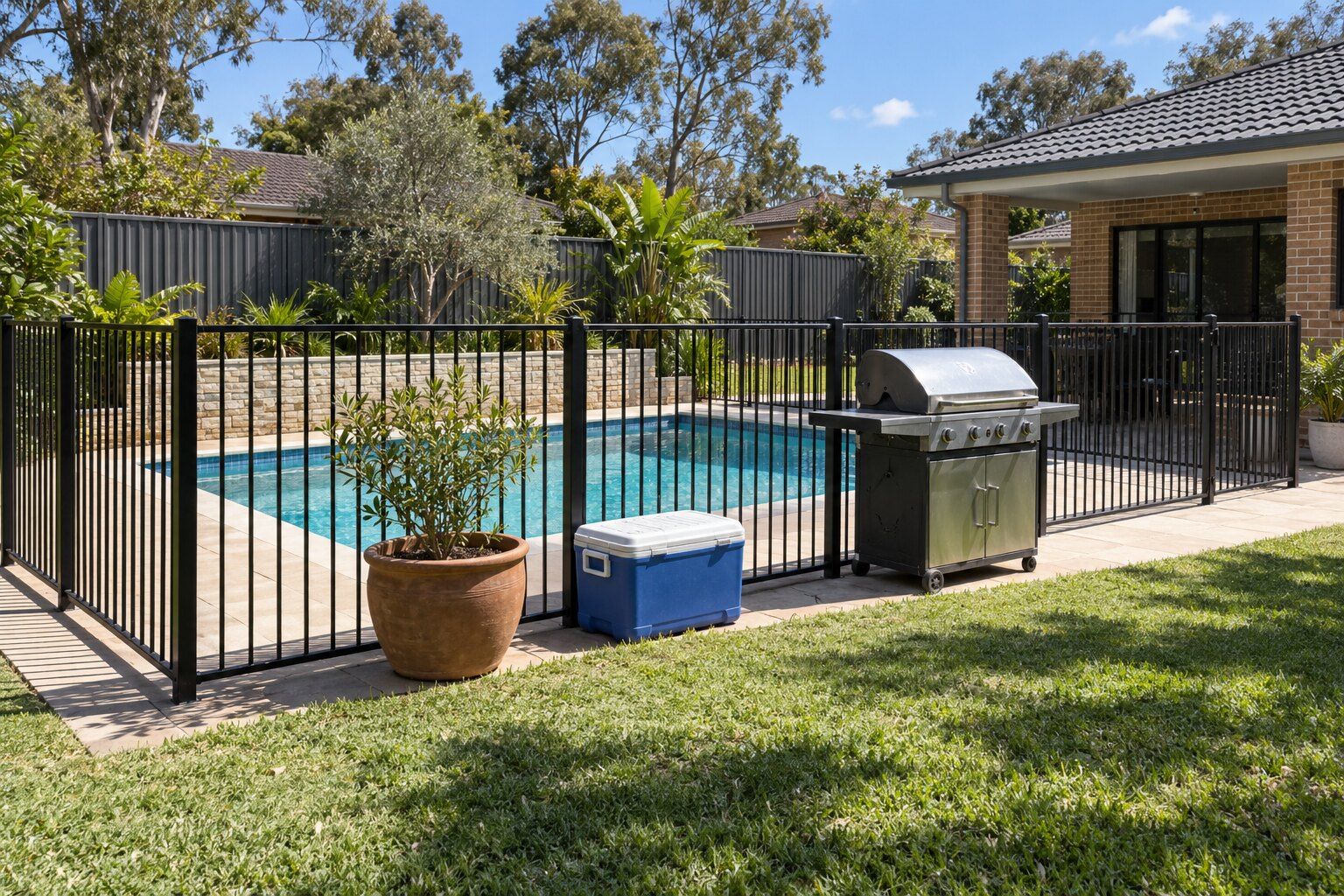
The register checklist says there must be no potential hand holds or foot holds within 900 mm of the top of the pool fence in any direction. The NSW Government's guide calls this the 90 cm non-climbable zone. Picture an arc 900 mm out and down from the top rail on the outside of the fence. Anything a child could climb inside that arc is a problem.
Common things that end up there:
- Pot plants, eskies, chairs, barbecues and outdoor toys pushed against the fence
- Tree branches and shrubs that have grown over or along the fence
- Retaining walls, garden edging, steps and taps close to the fence line
- Pool equipment covers, hose reels and storage boxes
- Horizontal rails or brackets on the fence itself that sit less than 90 cm apart
Moving loose items is the cheapest fix there is, but they have to stay moved. A certifier assesses what is there on the day, and the barrier has to stay compliant afterwards.
The 300 mm zone inside the pool area
The NSW Government's guide also covers the space extending 30 cm inside the pool area. Keep that strip clear of anything climbable as well.
In practice that means not stacking pool toys, chairs or pot plants against the inside face of the fence, and keeping garden beds on the pool side from building up against it.
How to check your own fence before the inspection
- Walk the full barrier, including any boundary fence, house wall or gate that forms part of it.
- Measure the height from the outside ground at several points on every run. Note anywhere under 1.2 m, or under 1.8 m on a boundary fence measured from the pool side.
- Check the gap under the fence and between bars or panels with a 10 cm gauge.
- Stand outside the fence and look for anything climbable within 900 mm of the top rail, then check the 300 mm strip inside.
- Open each gate to different positions and let go. It should swing shut and latch by itself every time.
- Write down anything that fails, with a photo, so a fencing contractor can quote on the list.
The free pool barrier checker walks through the same items one at a time. The pool compliance checklist covers gates, doors, windows and the CPR sign as well.
Your measurements are a guide only
Your own check helps you find the obvious problems. Whether the barrier complies is decided by a registered certifier or your council, using the Australian Standard that applies to your pool.
Common questions
What is the minimum pool fence height in NSW?
1.2 m, measured from finished ground level outside the pool area. The NSW Swimming Pool Register checklist says it must be at least 1200 mm high all the way around.
How high does a boundary fence need to be if it's part of the pool fence?
1.8 m. The register checklist measures it from the inside of the pool area, so the height on your neighbour's side doesn't settle it.
How big can the gap under a pool fence be?
No more than 10 cm from finished ground level. Gaps between vertical bars or panels have the same 10 cm limit.
Can I have a pot plant next to my pool fence?
Not if it's within the 900 mm non-climbable zone on the outside of the fence, or against the inside of the fence within the 300 mm zone. Move it well clear of the fence line.
Who fixes a pool fence that's too low?
A fencing contractor, or another tradesperson whose licence covers that material, such as glazing for glass. Work over $5,000 including GST needs a contractor licence. A certifier then re-inspects the barrier.
Where this information comes from
The prices, rules and advice on this page come from these published pages, checked on 16 October 2026.
- NSW Government: Owning a pool or spa, your obligations · Building Commission NSW guide to barriers, registration, sale and lease certificates and CPR signs (updated 16 March 2026)
- NSW Swimming Pool Register self-assessment checklist (pools built after 1 May 2013) · Register checklist rehosted by Oberon Council, undated
- NSW Government: Fencing work licences · When residential fencing work needs a contractor licence